

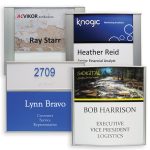
Walk through any professional building, and the office door signs tell you a lot — not just about who sits where, but about how the organization operates.
Mismatched signs, blank frames, or handwritten labels on tape signal a business that hasn’t thought through its signage. A clean, consistent system of office door signs signals professionalism, organization, and attention to detail. It’s a small thing that visitors and clients notice immediately.
But here’s what most businesses don’t think about when buying office door signs: the purchase isn’t just about today. It’s about every employee change, every room rename, and every departmental shuffle that will happen over the next five years. Buy the wrong system, and you’ll be paying a sign shop to keep up with your own growth.
This guide covers what you need to know to buy office door signs the right way — the types available, what drives cost, and why a changeable insert system is the smartest long-term investment for most businesses.
Types of Office Door Signs
Not all office door signs are the same. Understanding the main categories helps you match the right product to your specific needs.
Engraved or Printed Panel Signs
The traditional option. These are custom-fabricated signs with the name, title, or room designation permanently engraved or printed onto the face of the panel. They look sharp and feel substantial—but once they’re made, they’re fixed. Any change means ordering a new sign.
Best for: permanent installations where the content will never change—a main reception sign, a partner’s office in a law firm, a branded conference room with a permanent name.
Nameplate Frame Signs with Changeable Inserts
A sign frame, typically aluminum, that holds a printed paper or cardstock insert. The frame stays mounted on the wall permanently. The insert changes as needed and is printed in-house on a standard office printer.
This is the system used by Vista System, and it’s the category that makes the most financial sense for most office environments. Updates take minutes and cost almost nothing.
Best for: any office with regular personnel changes, growing teams, multi-tenant spaces, or frequent room reconfigurations.
ADA-Compliant Door Signs
Required by the Americans with Disabilities Act for permanent rooms and spaces — restrooms, conference rooms, exits, and offices with assigned occupants. ADA-compliant signs include tactile (raised) characters and Grade 2 Braille so visually impaired individuals can identify spaces by touch.
ADA compliance is not optional for most commercial facilities. If your office is open to the public or houses employees, ADA signage requirements apply.
Vista System offers ADA-compliant frames that work with changeable inserts — the tactile Braille overlay remains fixed on the frame while the printed insert behind it can still be updated.
Best for: any permanent room or space in a commercial facility — required by law in most cases.
Illuminated Door Signs
Backlit or edge-lit signs used for high-visibility environments—executive suites, hospitality, healthcare, or anywhere ambient lighting is low. These are typically custom fabrications and carry a higher price point.
Best for: premium environments where visual impact justifies the added cost.
Modular Directory and Multi-Panel Systems
Configurations that combine a header panel, multiple name or room inserts, and optional directional components into a single mounted unit. Common in multi-tenant office buildings, medical practices with multiple providers, or law firms where multiple names need to appear on one door or wall section.
Best for: shared suites, professional service firms, or any space where multiple people or functions need to be identified at a single location.
What to Look for When Buying Office Door Signs
Material and Finish Quality
The frame material determines how your signs look and how long they last. Aluminum frames, like those in the Vista System line, hold their finish, resist warping, and maintain a professional appearance for years. Plastic frames are cheaper upfront but show wear faster and can look dated in professional environments.
Finish options include brushed silver and black. Choose a finish that complements your office interior and, more importantly, apply it consistently across your entire sign system. Mismatched finishes are one of the most common signage mistakes businesses make.
ADA Compliance
If your office is a commercial facility, which includes virtually any business that employs people or serves the public, ADA-compliant door signs are a legal requirement for permanent spaces. This is not an area to cut corners on. Non-compliant signage can expose your business to accessibility complaints and required remediation costs that far exceed the cost of doing it right the first time.
When in doubt, specify ADA-compliant frames for all permanent room identification signs.
Consistency Across the System
One of the most common signage mistakes is buying door signs piecemeal. A nameplate here, a room sign there, a directory from a different vendor. The result is a mismatched system that looks unprofessional regardless of the quality of individual pieces.
A modular system like Vista System is designed so that all components, door signs, directional signs, room identifiers, and directories all share the same frame profile, finish, and design language. Specifying one system for your entire office produces a cohesive result that looks intentional.
Updateability
This is the factor most buyers overlook. Ask yourself honestly: how often does your office change? If the answer is “regularly”, namely new hires, departures, room reconfigurations, then a sign system that requires a vendor call for every update is the wrong choice.
Changeable insert door signs eliminate that dependency entirely. The frame is a one-time purchase. Every update after that costs you paper and ink.
The Cost of Office Door Signs — What to Expect
Office door sign pricing varies widely based on type, material, and configuration.
Engraved or custom-printed panel signs: $50–$300 per sign, plus lead time of 2-6 weeks per order. Each update requires a new order at full price.
Changeable insert sign frames (Vista System): $30–$120 per frame depending on size and configuration. Updates cost cents; paper and ink only.
ADA-compliant signs: Add $20–$60 to the base frame cost for tactile and Braille overlays. Required for permanent spaces regardless of sign type.
Illuminated signs: $150–$500+ per sign. Justified in premium environments; unnecessary for standard office use.
The math on changeable insert systems becomes compelling quickly. A 20-person office that replaces 5 door signs per year at $75 each spends $375 annually just keeping up with personnel changes before accounting for room reconfigurations or rebranding. A changeable insert system eliminates that recurring cost entirely after the initial frame investment. Check out the post on office signs that save you money for additional information.
Installation — What You Need to Know
Most office door signs mount using one of three methods:
Double-sided tape or adhesive strips: Easy, damage-free installation suitable for most interior walls and door frames. Works well for lightweight aluminum frames.
Screw mounting: More permanent, preferred for heavier configurations or high-traffic areas where signs may be bumped or disturbed.
Standoff mounting: A design-forward option where the sign is mounted slightly off the wall on hardware standoffs, creating a floating appearance. Common in executive and professional environments.
Vista System frames include multiple mounting options and are designed for straightforward installation without requiring a contractor. Most single-door sign installations take under 15 minutes.
What size should office door signs be?
Standard office door nameplate signs are typically 2″ x 8″ or 2″ x 10″ for single-name applications. Larger configurations, multi-name panels, or room identifier signs run from 6″ x 6″ up to 12″ x 12″ or larger. ADA standards specify minimum character heights and mounting heights (centerline between 48″ and 60″ from the floor) that should guide your specification.
Are office door signs required to be ADA compliant?
Yes, for permanent spaces in commercial facilities. The ADA requires tactile characters and Grade 2 Braille on signs identifying permanent rooms, offices, conference rooms, restrooms, and similar spaces. Signs for temporary use or non-permanent spaces are exempt. When in doubt, consult ADA Standards for Accessible Design or specify ADA-compliant signs across the board.
Can I print my own inserts for office door signs?
Yes, with a changeable insert sign system like Vista System. The frames are designed to accept paper inserts printed on a standard office laser or inkjet printer. Insert templates are sized to fit each frame so your text and graphics align correctly.
How do I make my office door signs look consistent across the whole office?
Specify a single modular sign system for all applications. Choose one frame profile and one finish, brushed silver or black, and use it throughout. Avoid mixing frame styles or finishes from different vendors. Different size frames within the same family are quite common.
What’s the difference between a nameplate sign and a room sign?
A nameplate sign identifies the occupant of a space such an employee’s name and title. A room sign identifies the function of the space, such as “Conference Room A,” “Server Room,” or “Break Room.” Both use the same frame types and can be part of the same sign system. In changeable insert systems, both are updated the same way: print a new insert and swap it in.
Do office door signs work for medical or healthcare offices?
Yes. Vista System signs are used in medical offices, clinics, and healthcare facilities. ADA compliance is especially important in healthcare environments. Changeable insert frames are particularly practical in medical offices where provider names, suite assignments, and room functions change regularly.
Can I order office door signs on a GSA contract?
Yes. We hold a GSA contract and can fulfill orders for federal, state, and local government agencies under contract pricing. Contact us for GSA schedule pricing and ordering details.
Office Door Signs in a Nutshell
Your office door signs are often the first thing clients and visitors see when they arrive. Make sure they’re sending the right message.
Browse our full line of Vista System office door signs — nameplate frames, ADA-compliant options, modular multi-panel configurations, and complete office sign systems available in a range of finishes.
Not sure which system is right for your space? Give us a call or request a quote we’ll help you specify the right frames, finishes, and configurations for your office layout and budget.
