

Vista System is a modular aluminum sign frame line built around changeable inserts, and in the United States it is sold through authorized resellers Vista calls Ambassadors. Buying it well comes down to four decisions: the frame family, the insert size, how ADA content is handled, and who you order from. This guide walks through each one.
At Sign-Frame we have sold and specified Vista products for more than 21 years, from a single office door to campus-wide sign schedules. If you are still deciding whether changeable signage fits your building at all, start with how changeable Vista signage compares with traditional signs. This post assumes you have already decided and want to get the order right the first time.
Who Makes Vista System Signs and Where Do You Buy Them?
Vista System LLC, based in Sarasota, Florida, designs and manufactures the frames, but it does not sell directly to end users. Facility teams, contractors, and architects buy through Vista Ambassadors, which are resellers trained and authorized on the full product line.
Sign-Frame is a Vista Ambassador. Our online Vista System store carries the most popular sizes, and anything in the full Vista System catalog (PDF) can be ordered through a quote, including families and custom sizes you will not find listed online. We ship across North America, hold a GSA contract for government buyers, and take Canadian orders by phone or email.
That distinction matters on a project. A reseller who knows the entire catalog can solve an odd wall, a long room name, or a tricky ADA condition with an existing part instead of a custom fabrication with a long wait.
Which Vista System Family Should You Choose?
Choose the family by the look you want and the insert you plan to use. Curved Vista and Nova frames suit paper inserts printed in-house, flat Square frames give a clean modern profile, frameless Sharp frames are made for interiors, and VRS frames fit specs that call for square corners and metal panels.
Vista describes its classic family as the first curved modular sign system, and it remains the workhorse for corridors and offices. Vista also makes illuminated (Light), fabric, art, expandable, display, and brochure holder families. You can browse the complete list of Vista product families on the manufacturer’s site, and we can quote any of them.
| Family | Profile and look | Inserts it takes | Where it is used | Best fit |
|---|---|---|---|---|
| Vista (classic) | Curved face, portrait or landscape, plastic or metal end caps, silver or black anodized (custom colors available) | Paper and most flexible materials | Indoor and outdoor sets | Corridors, offices, and campus standards with frequent changes |
| Vista Nova | Gentle curve with wide paneled sides | Paper, engraved, photopolymer, vinyl, tactile | Indoor and outdoor | Lobbies, premium office floors, directories |
| Vista Square | Flat profile, grey or black end caps, optional floating mount | Flexible and rigid inserts | Mostly indoor; projecting versions handle outdoor | Modern interiors, libraries, menu boards |
| Vista Sharp | Frameless look, 2- or 4-sided aluminum extrusion | Paper or rigid panels such as Dibond | Designed for indoor use | Reception, executive suites, glass-heavy interiors |
| VRS | Square-cornered architectural aluminum, silver or black anodized | Metal or Dibond face panels; slider and channel options | Room ID and wayfinding | Architect specs that call for a squared-off frame |
One family per building is the safest default. You can mix families on purpose, such as Sharp in the reception area and classic Vista in the corridors, but decide that in the design phase. Mixing by accident, one order at a time, is how a building ends up looking like it was signed by three different vendors.
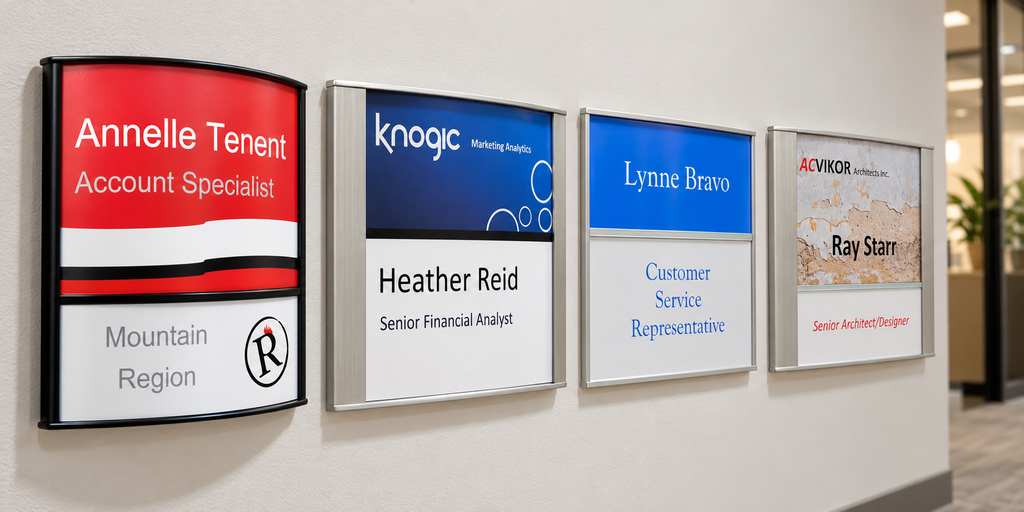
How Do You Size Vista Sign Frames Correctly?
Size from the insert, not the frame. Every Vista profile has three widths: the overall sign, the insert, and the visible area, and the visible area is always a little smaller because the frame covers the insert’s edges.
Here is a real example from Vista’s own size table: the V-LETTER profile takes an 8.5-inch-wide insert, but about 8.23 inches of it is visible. Designers who run text or a colored band right to the edge of the file lose it under the frame. Keep a margin on every template, and print a test insert before you print a hundred.
The second sizing mistake is planning for the average name instead of the longest one. A frame that fits a short last name will not fit a long title like Director of Environmental Health and Safety at a readable size. Pull the longest room name and title in the building before you pick a width. Our Vista sizing chart lists the standard heights and widths we stock online.
How Do ADA Signs Work With Changeable Vista System Inserts?
Put the permanent information on a tactile ADA lens and the changeable information on a paper insert. Under the 2010 ADA Standards, room numbers and permanent room names need raised characters and Grade 2 braille, while occupant names and titles are exempt from both visual and tactile requirements.
The U.S. Access Board’s guide to ADA sign requirements spells this out, and it is the reason changeable ADA signs work. Our Vista ADA office sign frames use a 1/16-inch acrylic lens with surface-applied tactile letters and friction-fit braille, set into the aluminum frame. Clear ADA lenses are designed to sit over a paper insert you print yourself. Colored and wood-look lenses carry everything on the lens and do not need one.
When someone moves offices, a staff member removes the lens with a suction cup, swaps the paper insert, and puts the lens back. The room number never changes, so the tactile part never needs replacing.
Placement still has to follow the standard. Tactile characters must sit between 48 inches above the floor, measured to the baseline of the lowest tactile line, and 60 inches, measured to the baseline of the highest. The sign goes on the latch side of the door, with an 18-by-18-inch clear floor space centered on it and outside the door’s swing. California projects add Title 24 rules, covered in our guide to California Title 24 sign requirements, and we offer California braille on request.
Vista System Selection Matrix
Match the situation to a family, an insert approach, and an ordering path. This matrix reflects how we typically spec Vista System projects for healthcare, university, and commercial buildings.
| Situation | Recommended family | Insert approach | How to order |
|---|---|---|---|
| Hospital or clinic corridors with frequent staff changes | Vista classic, one size per sign type | Clear ADA lens over an in-house printed paper insert | Quote with a sign schedule |
| University offices spread across many buildings | Vista or Nova, one family campus-wide | Paper inserts from a shared template | Quote for the rollout, online for add-ons |
| Lobby directory that changes with tenants | Vista or Nova directory | One strip insert per tenant or department | Online for standard sizes, quote for custom |
| Reception area or executive floor | Sharp or Nova | Rigid printed panel or paper | Quote |
| Contractor bid with an architect’s spec | The family named in the spec | As listed in the submittal | Quote with submittals and samples |
| A few door signs needed this week | Vista classic quick-ship sizes | Paper | Online; ships next business day if ordered before noon Eastern |
| Exterior or covered outdoor locations | Vista outdoor sets | Weather-resistant lens with vinyl graphics, no paper | Quote |
Directories deserve a note of their own. A tenant directory changes more than any other sign in a building, so pick a profile with individual strips rather than one large panel. Our Vista directory sign frames are built that way, which means one tenant change is one strip, not a reprint of the whole board.
What Should a Vista System Spec or Submittal Include?
A complete spec names the family, profile and size code, finish, end caps, mounting method, insert material, and the ADA lens details for every sign type. Leave any of those out and the bid prices will not be comparable.
The detail that catches contractors most often is finish. Our quick-ship Vista frames come only in brushed silver with grey or black plastic end caps. If the spec calls for black anodized frames or metal end caps, quick ship is off the table, so know that before you promise an owner a date.
Mounting is the other one. Vista frames can go up with screws, double-sided tape, or silicone, and the right choice depends on the wall. Tape works on smooth painted drywall, but it is a poor bet on textured surfaces, glass with film, or anywhere the sign might be pulled. Call it out in the submittal so the installer is not guessing on site.
We prepare sign schedules, proofs, samples, and submittals for medium and large projects. For owners who want the program to stay consistent after turnover, pair the spec with a written standard; our post on building a cohesive signage standard covers what that document should include.
Vista System Lead Times and Ordering Paths
At Sign-Frame, quick-ship frames ship the next business day, standard Vista frames take about 10 days, and custom ADA inserts take 10 to 15 business days. That is far shorter than the three-to-six-month timelines many project buyers run into with fully custom sign fabrication.
Online orders default to ground shipping, which can take up to five business days depending on location. Expedited shipping is available by phone. Every ADA sign and printed insert is proofed for your approval before production, so build a day or two for review into your schedule.

Key Takeaways
Frequently Asked Questions
Can you buy Vista System signs directly from Vista?
No. Vista System sells through its network of Ambassadors, which are authorized resellers trained on the product line, rather than directly to end users. Sign-Frame is a Vista Ambassador, so we can supply anything in the current Vista catalog, including sizes and families not listed in our online store. Popular sizes can be ordered online, and larger projects go through a quote.
What is the difference between Vista and Vista Nova sign frames?
Both are curved Vista sign frames that take changeable inserts. The classic Vista profile has a curved face capped at each end, while Nova pairs a gentler curve with wide paneled sides that frame the insert. Classic Vista comes in more sizes, with its largest profile about 48 inches wide. Nova reads as slightly more upscale and suits lobbies and executive floors.
Can ADA signs use changeable paper inserts?
Yes, as long as the tactile content stays permanent. Room numbers and permanent room names need raised characters and Grade 2 braille, but occupant names and titles are exempt under the 2010 ADA Standards. A clear ADA lens carries the tactile content, and a printed paper insert behind it shows the name, so staff can update it in minutes without replacing the sign.
How long does it take to get Vista System signs?
At Sign-Frame, quick-ship Vista frames ship the next business day when ordered before noon Eastern. Standard Vista frames take about 10 days, and custom ADA inserts take 10 to 15 business days. Ground shipping adds up to five business days depending on location, and expedited shipping is available by phone. Large projects are scheduled around your sign schedule and approvals.
Do Vista sign frames fit standard letter-size paper?
Yes. Vista makes letter-size profiles in several families, including the classic V-LETTER, the Nova VN-Letter, and the Square F-Letter, each built for an 8.5-inch-wide insert. Plan for a slightly smaller visible area because the frame covers the edges. On the V-LETTER, about 8.23 inches of the insert shows, so keep text and color bands away from the edges.
Can government agencies buy Vista System signs through GSA?
Yes. Sign-Frame holds a GSA contract, which gives federal buyers a compliant way to purchase Vista System products. Check GSA Advantage for the items and pricing currently listed, or request a quote and we will confirm which products and sizes are on the contract before you order. We also handle sign schedules and submittals for government projects.
Ready to Spec Your Vista System Project?
The Vista System rewards buyers who make a few decisions up front: one family, the right insert size, a clear plan for ADA content, and a reseller who knows the whole catalog. Get those right and the signs stay current for years with nothing more than a printer and a suction cup.
Send us your floor plans or sign schedule through our request a quote form, or call 1-866-299-9933 to talk through families, sizes, and ADA details with someone who has specified Vista for more than two decades.
