

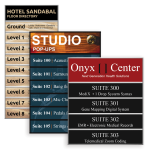
Directory signs help most visitors decide how comfortable they feel inside a building within seconds of walking through the door. This occurs before they notice finishes or architecture, as they just want confirmation that they belong there. When properly designed and implemented, people simply get where they need to go. Should that not occur, visitors become confused, and effective building navigation falls apart.
From our experience, a directory sign does more than list names. Directory signs set expectations and communicate to visitors that the building and its tenants are well-managed. The difficulty comes from choosing the right type. Many directory signs look similar at installation but perform very differently over time. Buildings change constantly, and signage either adapts or becomes a recurring problem. Understanding the differences early avoids frustration later.
Traditional Engraved Directory Signs
Engraved directory signs built the foundation of modern wayfinding. On these directories, names and locations are permanently engraved on a surface, usually plastic or metal. They signal permanence, established and solid, explaining why older facilities still rely on them. That said, the illusion of permanence becomes a real disadvantage as soon as changes are needed. When a new tenant arrives or a department relocates, the directory becomes problematic because replacing panels takes time, assuming the local sign company is still in business, which isn’t always a certainty. Matching materials years later can be surprisingly difficult, and many buildings develop slight visual inconsistencies that accumulate over time.
Engraved building directory signs still serve places where change rarely occurs. Those environments simply represent a shrinking portion of commercial space today.
Panel-Based Office Directory Signs
Panel systems attempted to solve the update problem by dividing directories into replaceable sections. Individual tenant panels can be updated without rebuilding the entire display. For many years, this approach represented substantial progress. Office directory signs constructed from panels reduced waste and simplified revisions. Even so, updates commonly require tools or vendor involvement. Replacement panels ordered years apart may vary slightly in finish or color.
These systems work reasonably well in buildings with moderate turnover. Yet managers responsible for active properties often discover that updates still take more effort than expected. The search for simplicity continued from there.
Changeable Directory Signs and Insert Systems
Changeable directory signs introduced a practical shift in thinking. The model assumed changes would occur rather than thinking the content would remain static. With these systems, the architectural frame remains in place, while only the printed insert changes. When occupants change, inserts are replaced rather than structural components.
That distinction matters more than it first appears. Updates can happen the same day information changes. Staff handle revisions internally without specialized tools. The directory sign remains uniform because the frame never changes.
Facilities with frequent movement quickly recognize the advantage. Medical offices, corporate environments, churches, and multi-tenant buildings benefit immediately from this pliability. Over several years, changeable building directory signs tend to reduce both maintenance effort and replacement cost. More importantly, they remove signage from the list of recurring operational headaches.
Modular Architectural Directory Signs
Modular directory signs build on insert-based systems by providing a common look-and-feel throughout the building or campus. Rather than installing individual sign types, modular systems such as Vista System create a coordinated suite of signs that includes directories, hallway signs, and office identification, all working together visually.
Adding new signs in this scenario is no problem. Updating existing signs can be done naturally and consistently while keeping the theme intact throughout the building. This is especially important when new facilities managers join with no prior knowledge of the existing sign system.
Architects often prefer modular systems because they maintain design consistency. Property managers appreciate that updates remain simple long after construction ends. Because buildings evolve, departments grow, and tenants change, most companies implement a uniform sign code to ensure this consistency is maintained regardless of who is in charge.
Digital Directory Signs
Digital directory signs are the next level up from modular signs, and the leap is quite significant. The majority of digital directory solutions are eye-catching, vibrant, and ideal for attracting attention. They enable instant updates and, with interactive directories, searchable listings.
Typically found in large corporate lobbies, hotels, and medical buildings, digital directories are ideal for enhancing the overall wayfinding experience and offering flexibility that static systems cannot match. The added flexibility that digital directories offer comes with challenges. First, digital directories are not inexpensive. Prices vary significantly but typically exceed those of its modular counterpart by an exponential amount. Training is required to manage the messaging through proprietary software. Power is required at the site, which, if not currently present, can be quite costly to run. Screens do require maintenance and can be problematic during system issues and power outages, where navigation goes away completely.
Reliability is paramount for wayfinding. Physical directory signs continue to provide dependable guidance, whereas technology adds convenience. As with any decision, there are puts and takes with each.
Comparing Directory Sign Solutions in Real Buildings
Permanent directories often lead to delayed updates and short-term fixes that compromise appearance, as discussed previously. Flexible systems, on the other hand, including changeable and modular directory signs, are specifically designed to avoid that problem.
Most of our clients find that adaptable systems are typically more efficient, both visually and financially, over the long haul. More importantly, they monetize the value of their time and choose not to allocate precious cycles to addressing signage-related issues.
Choosing the Right Directory Sign for Your Facility
Selecting the right directory sign starts with an honest assessment of how your building operates. Consider how often your tenants or listings change and who’s responsible for managing these updates. Consider the overall look and feel throughout the building and if signage consistency matters.
Directory signs usually anchor broader wayfinding programs for offices, desks, cubicles, and hallways. Modular systems, especially office signs, are designed with that in mind, enabling ongoing additions and changes while maintaining existing aesthetics.
Practical Considerations from Real Directory Sign Installations
In facilities where we install, we find that directory signs rarely fail due to design. They fail because the system cannot keep up with operational change.
Property managers often figure it out once tenants start coming and going. A directory that looked great post-installation suddenly looks tired and out of place. Replacement panels take time, temporary labels appear, and visual consistency slowly declines. More often than not, we see Post-it notes with handwritten text attached to the signs. Not a great look for a business environment.
Facilities managers who plan for change from the beginning typically avoid these issues. Changeable, modular directory signs allow updates without replacing structural components, keeping both maintenance costs and downtime low.
From an operational standpoint, the most successful directory systems are the ones staff can update quickly without outside coordination.
Why Modular Directory Signs Continue to Gain Favor
Decision-makers across the business spectrum have prioritized adaptability in their management and facility responsibilities. Key to that are modular directory signs, which meet aesthetic needs and solve day-to-day business problems. Modular systems maintain a refined architectural presence without locking buildings into permanent messaging.
When done properly, directory signs become understated, allowing visitors to find their destinations naturally. It’s this, among other factors, that has contributed to the overimpact of modular directories over the last several years. Please reach out should you require additional information for your place of business.