Why women’s restroom signs still matter
Clarity and speed of wayfinding. Dedicated signage lets people find a restroom quickly without hesitation, which matters most in high-traffic places like airports, stadiums, and schools, where wait times and crowd flow are real logistical issues. Safety and comfort. Many women report feeling safer in single-sex facilities, particularly in public settings, and separate restrooms remain the default expectation in most commercial and institutional buildings.
Cultural, religious, and personal needs. For some people, single-sex facilities matter for religious or cultural reasons, or simply personal comfort — needs a building’s signage should be able to accommodate.
Legal and building-code compliance. In most U.S. jurisdictions, multi-user restrooms are still required to be designated by sex, with specific signage standards. All-gender restrooms are frequently added to a building’s facilities rather than substituted for single-sex ones. None of this makes all-gender signage less important. All-gender and single-occupancy restrooms matter enormously for transgender and nonbinary people, parents with kids of a different gender, and caregivers assisting someone with a disability. The two signage systems solve different problems, and a well-designed building typically offers both.
[||]
What the law actually requires
Restroom signage isn’t just a design choice — it’s regulated. Here’s what generally applies in U.S. commercial and public buildings:
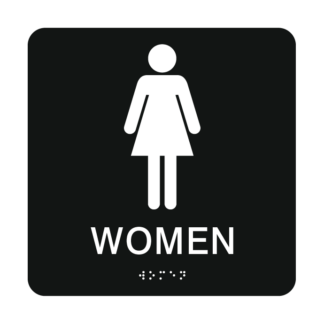
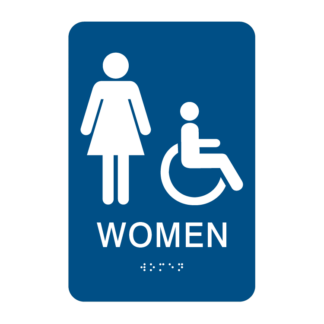
ADA (federal) requirements. Under the 2010 ADA Standards for Accessible Design, restroom identification signs must include raised tactile characters between 5/8 inch and 2 inches tall, with Grade 2 Braille placed directly below the text. The ADA treats restroom signs as permanent room identification signs, so they’re subject to strict rules on tactile characters, Braille, contrast, and mounting location.
-

Women’s Restroom Non-Accessible ADA Braille Sign – 8×8
$79.99 Select options This product has multiple variants. The options may be chosen on the product page -
Women’s Restroom Accessible ADA Braille Sign – 9×6
$56.99 Select options This product has multiple variants. The options may be chosen on the product page -
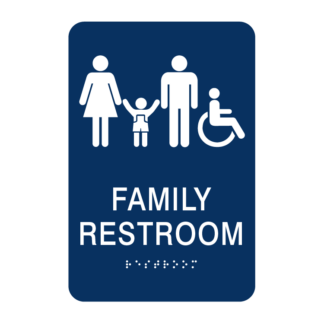
Family Restroom Accessible ADA Braille Sign – 9×6
$56.99 Select options This product has multiple variants. The options may be chosen on the product page -
California Geometric Non Accessible Women’s Door Sign – 12″
$123.99 Select options -
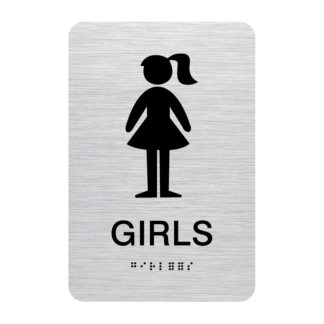
Girl’s Restroom Non-Accessible ADA Braille Sign – 9×6
$56.99 Select options This product has multiple variants. The options may be chosen on the product page

Shape conventions. Doorways to a men’s restroom are typically marked with an equilateral triangle, while women’s restrooms use a circle; gender-neutral restrooms often combine both shapes — a triangle superimposed on a circle. The ADA itself doesn’t strictly require pictogram shapes; the tactile text and Braille are the actual federal requirement, and pictograms are commonly layered on top by convention or state code.
Mounting height and location. ADA-compliant signs generally must sit within a specific height range (roughly 48–60 inches from the floor) on the latch side of the door, with clear floor space in front so someone using a wheelchair can approach and read the sign without the door swing getting in the way.
State add-ons. States can layer on additional requirements through their own building codes — California’s Title 24, for example, adds its own restroom door-sign rules. California’s AB 1732 (the Equal Restroom Access Act) separately requires that single-user restrooms be labeled as all-gender — a rule specific to single-occupancy rooms, not multi-stall facilities.
Penalties for noncompliance. Getting this wrong isn’t just a design slip. ADA signage violations can carry significant fines, and inaccessible signage creates real barriers and legal exposure for a business. The bottom line: single-sex signage and all-gender signage aren’t legally in conflict. In most places, codes require proper signage for sex-designated restrooms and, increasingly, options for all-gender or single-occupancy facilities.
[||]
Sign-Frame.com offers a wide range of compliant, high-quality women’s restroom signs, men’s restroom signs, and all gender restroom signs. The choices can be overwhelming, but we are here to help. If you can’t find exactly what you are looking for, reach out to us, we’ll be happy to help you select the right sign option from the thousands of signs in our Vista Systems catalog.
[||]
Women’s Restroom Signs – Common Questions
It depends on where you are. Requirements vary by jurisdiction and building type — some states and cities mandate all-gender restroom options in certain facilities, while others leave the decision to the building owner. Local building codes are the source of truth for any specific address.
By common convention (and in several state codes), a circle designates women’s restrooms, a triangle designates men’s, and a triangle-over-circle marks gender-neutral restrooms. That said, the ADA itself doesn’t strictly mandate these pictogram shapes — the legally required elements are the tactile text and Braille; the shapes are a widely used design convention layered on top.
Yes, for multi-user restrooms. Signs reading “Women” (or “Men”) must display the word in tactile, raised characters with Grade 2 Braille directly beneath it, so the sign works for sighted visitors and for visitors who are blind or low-vision alike.